霜降。 The year’s first frost — and autumn’s last page.
Shuāngjiàng (霜降) — “Frost’s Descent” — is the 18th of China’s 24 solar terms and the sixth and last term of autumn. In 2026, it begins on October 23. Two weeks later, the calendar turns over into winter.
Fifteen days earlier came Hánlù. A little over six weeks before that came Báilù. The three read the same water at three different temperatures. An old almanac sums this last one up in a single line: the air is severe and condensing, and the dew has bound itself into frost.
There is also something quietly wrong with the name. Frost does not descend. It forms where it already is — on the grass, on the soil, on a shed roof — out of water that never left the ground. Nearly two thousand years ago, the Eastern Han scholar Wang Chong put it plainly: what freezes into dew and frost, he wrote, rises from the earth and does not fall from the sky.
Frost does not fall. It arrives quietly, on the ground, and stays.
1. At a Glance: Three Signs of Late Autumn
Ancient observers divided Shuāngjiàng into three signs. Each one is quieter than the last:
- First sign: The jackals lay out their prey. Jackals begin hunting in earnest. The word worth noticing is “lay out” — they set their catch out in rows before eating it. To early observers it looked like an offering. It was really a matter of preparation: eat well while the hunting is good, and put aside what they can for the months ahead.
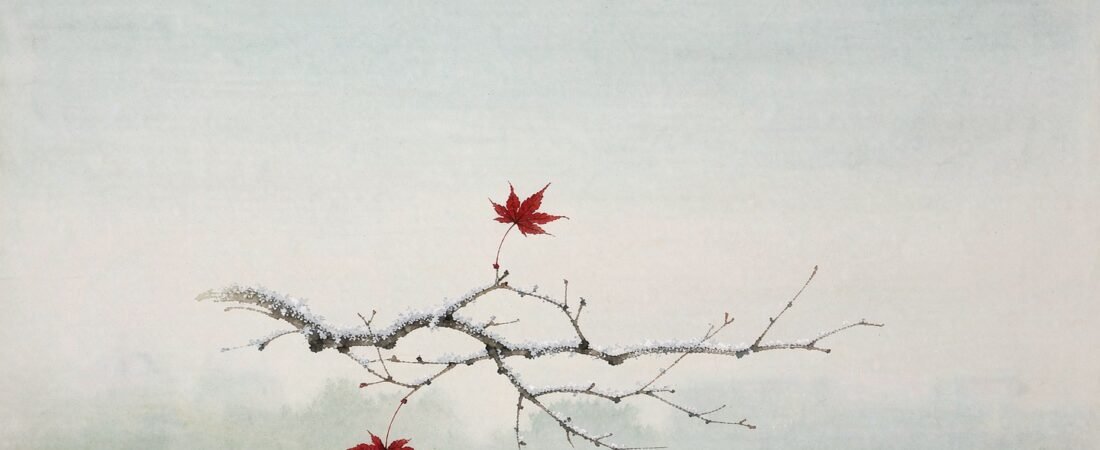
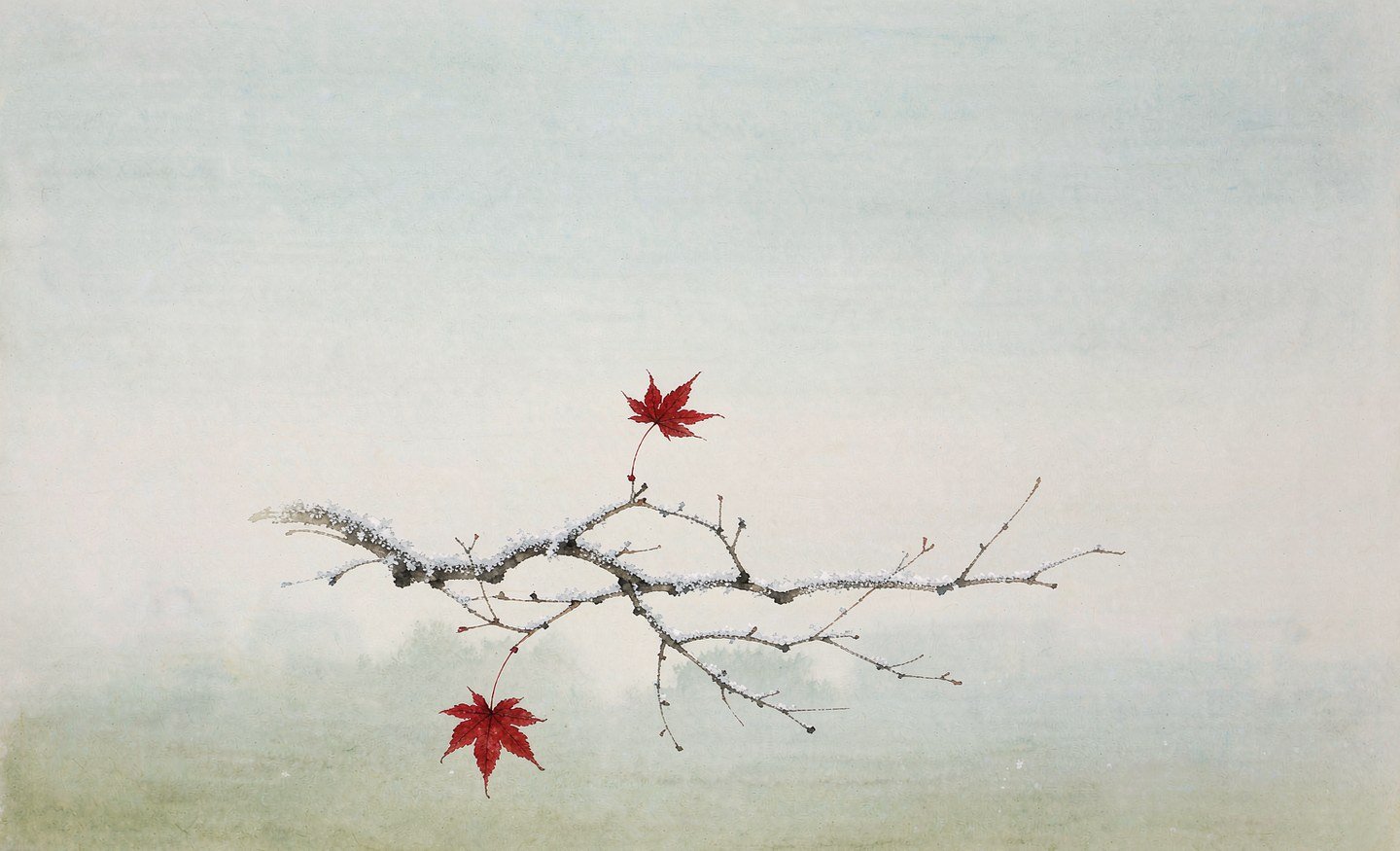
- Second sign: The trees and grasses turn yellow and drop. Frost brings growth to a stop. Green retreats out of the leaves, and wherever maples grow, the hillsides turn red rather than bare. It is the reddest fortnight of the year, and it arrives at the very end.
- Third sign: Everything that burrows lowers its head. “Lowers” carries the whole meaning — insects and worms settle into their burrows, motionless and not feeding, heads bowed, until the cold has passed. Above the ground, the field falls silent.
Read together, the three signs point the same way: the hunters are laying in supplies, the plants are letting go, and everything that creeps has gone quiet underground.
Three signs, all moving the same way: the hunters lay out their catch · the trees and grasses let go · everything that creeps lowers its head and goes quiet.
2. Where It Comes From
Shuāngjiàng begins when the sun reaches 210° celestial longitude.
It belongs to autumn’s three middle terms — Chǔshǔ, Qiūfēn and Shuāngjiàng — the three that fall in the second half of their lunar month. Within its own month it is the second of a pair: Hánlù opens the ninth lunar month, and Shuāngjiàng closes it.
The old almanac explains the name in one line: “Shuāngjiàng, the ninth month’s middle term — the air turns severe and condenses; the dew binds into frost.”
Báilù, Hánlù and Shuāngjiàng are three terms named for the same water at three different temperatures — one phenomenon, read three times like marks on a thermometer.
Think of the 24 solar terms as 24 waypoints on a nature calendar — Báilù is where the dew appears, Hánlù is where it turns cold, and Shuāngjiàng is where it stops being liquid.
3. The Story & Its Meaning
风卷清云尽,空天万里霜。
The wind sweeps the last clear clouds away; across ten thousand miles of empty sky, frost.
— Yuan Zhen, Odes to the Twenty-Four Solar Terms (Tang dynasty)
Yuan Zhen wrote one poem for each of the twenty-four terms. Across the opening couplets of this one he moves through Shuāngjiàng’s own signs: the jackals laying their catch out under the moon, and further along, the trees thinning to bare wood. It is the closest thing Shuāngjiàng has to a standard footnote.
The line to pause over is the second one: ten thousand miles of frost in an empty sky. We have just established that frost does not fall — so what is it doing up there? Nothing, of course. Once the ground has gone white, the horizon loses its edge. Look up or look down, and the white is the same. The poet was not being careless; he wrote the morning exactly as it looked from standing in it.
That is the meaning Shuāngjiàng carries. The end of a season does not announce itself. One morning the water on the grass is no longer water, the leaves have gone red and then let go, and the field is quiet without anyone having decided it should be. Everything has changed shape, and nothing made a sound.
4. The Energy of the Season
From the first days of autumn, the year has been doing one thing: gathering in. At Shuāngjiàng, gathering quietly becomes storing — and the storing is nearly done.
The jackals laying out their catch is storing. The trees drawing everything back into their roots before they drop is storing. The insects settled head-down in the soil have already finished.
Traditionally, this is not a season for starting something new. There is a farming saying for this week: see frost at Shuāngjiàng and the granaries will be full. It is a sentence about work already behind you — about having finished, rather than beginning anything.
Seen as a way of living, it is simply one notch further in: close what is nearly closed, leave some margin in the day, and let the loose ends of the year be gathered up rather than added to. Nothing here asks you to stop. It only suggests that stopping is allowed.
A season for closing drawers — not giving up, simply putting the year away in order.
5. How to Live With It
Here in Singapore, Shuāngjiàng is the one term in the whole series you will never see. Nights here rarely fall below 23°C, and frost cannot form. What we get instead is the inter-monsoon months of October and November: hot mornings, then thunderstorms in the afternoon and early evening, with rainfall climbing steadily from November onward. The old saying watches the ground for frost. Down here, what arrives out of the sky is simply rain.
A few simple, seasonal shifts are often enough:
- Carry a layer — mostly for indoors. Further north this is the fortnight that ends single-layer weather, with ankles and the back of the neck kept covered in the mornings and evenings. Here the arrangement reverses: the air-conditioning in a mall or an office is usually colder than the street outside, and a light layer in your bag is worth more than any number of warm intentions.
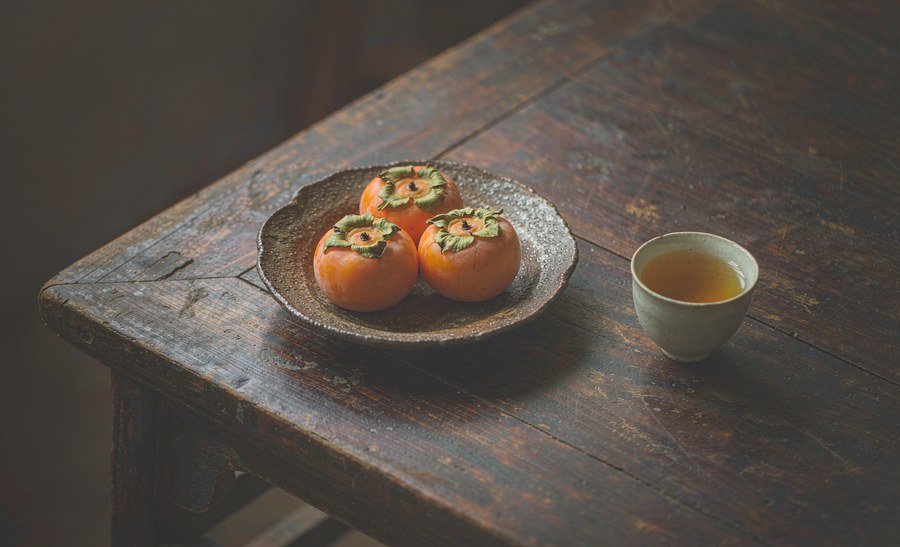
- Eat persimmons. They come into their own right now, soft and very sweet, and eating them at Shuāngjiàng is a custom kept in many parts of China. They ask nothing of you at all.
- Go out before the rain. If you want a walk, take it in the morning. By mid-afternoon the sky usually decides otherwise, and one glance at the horizon before you leave tells you most of what you need.
- Finish one thing. This is autumn’s last fortnight. One letter answered, one drawer emptied, one walk you keep postponing — closing a single small loop does more for the season than writing out a plan.
6. Your Lume Moment
After Shuāngjiàng, autumn has fifteen days left.
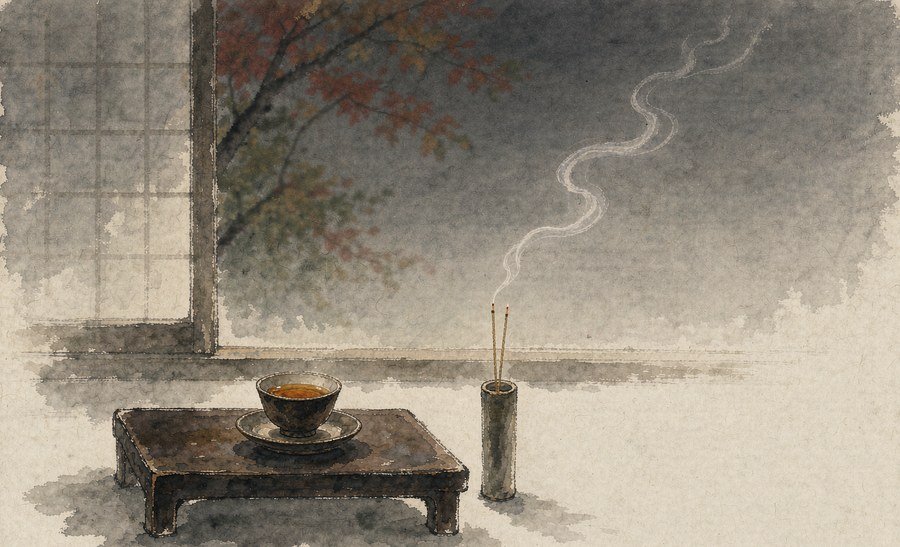
The most natural ritual of this season is to brew a warm cup of herbal tea. A plate of persimmons and a pot of tea is about as much ceremony as late autumn asks for. Our Poria & Sour Jujube Seed Tea carries an evening mood: quiet, unhurried, and made for the last hour of the day.
Light a single stick of incense, and let the tea and the soft thread of scent settle the room. (Our fragrance collection is launching soon; in the meantime, explore our incense collection.)
One cup of tea. One thread of scent. Autumn’s last page.
This is what Shuāngjiàng quietly teaches: the changes that matter most are often the ones you cannot hear. Frost does not arrive from anywhere. It forms exactly where you happen to be standing.